Saturday, September 17, 2011
St. Martin's Church
One of my most interesting discoveries thus far in Canterbury is St. Martin's Church. It is generally acknowledged to be the oldest church in England, parts of the building dating to Britain's Roman occupation. One can still see sections of the wall that are clearly Roman in architecture. Most of the nave was built around 597, when St. Augustine arrived to bring Christianity to the Saxons. Ethelbert, the king of Kent and the surrounding areas, had married a Christian Frankish wife named Bertha (from Tours, where St. Martin was bishop in the 4th century) and had already allowed her to use St. Martin's as a place of worship. Together, St. Augustine and Queen Bertha evangelised the Saxons, and King Ethelbert was soon baptised in that very church. Though the tower was added later in the Middle Ages, most of the structure remains intact as it was over 1,400 years ago, a fascinating remnant of the early mediaeval age as well as a monument to the work of the church in England. To this day, St. Martin's has always been actively used as a place of worship, first Roman Catholic and then Anglican, and I am very much looking forward to attending a service there. Unfortunately, the church is not well marked, so if you happen to be in Canterbury, take the A257 out of the town centre, past St. Augustine's Monastery and past H.M. Prison Canterbury (A257 will now be called St. Martin's Hill), and turn down a little one-way street on your left called Holmes Road (across from the turn onto Holmes is an interesting row of 17th-century poorhouses). The gate to the church will be directly ahead on Holmes. It is open on Tuesday, Thursday, and Saturday. It is well worth a visit!
Wednesday, August 31, 2011
The Fragrant Wood
c. 11th century
My hope, my love, we will go
Into the woods, scattering the dews,
Where we will behold the salmon, and
the ousel in its nest,
The deer, and the roebuck calling;
The sweetest bird on the branches
singing,
The cuckoo on the top of the green hill;
And death shall never find us
In the bosom of the fragrant wood.
Into the woods, scattering the dews,
Where we will behold the salmon, and
the ousel in its nest,
The deer, and the roebuck calling;
The sweetest bird on the branches
singing,
The cuckoo on the top of the green hill;
And death shall never find us
In the bosom of the fragrant wood.
Monday, August 29, 2011
"Elegy for Geraint" Welsh Battle Poem, circa A.D. 500
Before Geraint, the enemy's scourge,
I saw white horses, tensed, red,
After the war cry, bitter the grave...
In Llongborth, I saw the clash of swords,
Men in terror, bloody heads,
Before Geraint the Great, his father's son.
In Llongborth I saw the spurs
And men who did not flinch from spears,
Who drank their wine from glass that glinted...
In Llongborth I saw Arthur's
Heroes who cut with steel.
The Emperor, ruler of our labour.
In Llongborth Geraint was slain.
Heroes of the land of Dyfeint,
Before they were slain, they slew.
Under the thigh of Geraint swift chargers,
Long their legs, wheat their fodder,
Red, swooping like milk white eagles...
When Geraint was born, Heaven's gate stood open;
Christ granted all our prayers;
Lovely to behold, the glory of Britain.
Sunday, August 28, 2011
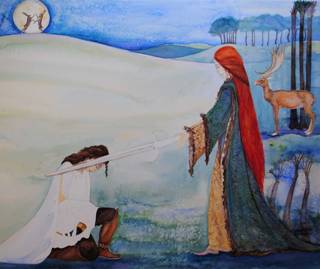
A small, ancient verse that amused me...
The hart, he loves the highwood,
The hare, she loves the hill,
The knight, he loves his bright sword,
The lady loves her will.
Subscribe to:
Posts (Atom)